session on critical AI practices at the digital conference
July 10, 2026
We recently organised a session on critical AI practices as part of the conference Digital Humanities Today: Critical Inquiry with and about the Digital. It was a hot day, but luckily the rooms were well ventilated. 🪭
Some brief notes on the session to share with those that wanted to join but couldn’t make it…
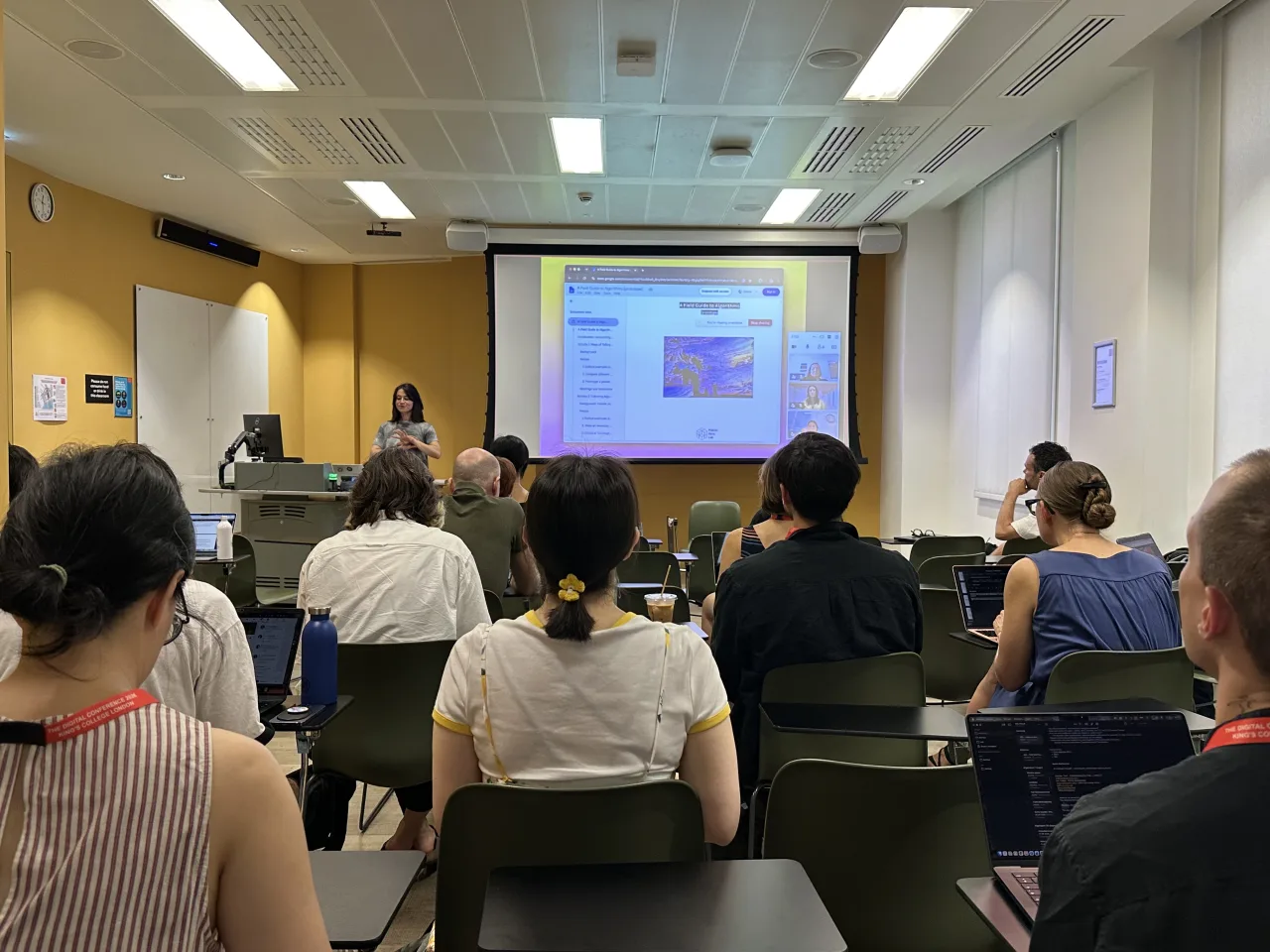
Liliana Bounegru started by situating the session in relation to previous collaborations with the Public Data Lab as a mushroom network of learning, exchange and collaboration.
She mentioned previous projects such as Climaps (led by Bruno Latour, which is one of the contexts where many people involved in the Public Data Lab met) as well as the Field Guide to Fake News and the Field Guide to Algorithms. These field guides both sought to modify collective inquiry - for example shifting focus from misleading content to the infrastructural conditions of its circulation.
She mentioned our previous work on critical data practices, including in the Data Journalism Handbook: Towards a Critical Data Practice and the chapter on critical data practices in my recent Public Data Cultures book. She mentioned how the session connected with the conference’s theme of “critical inquiry with and about the digital” (which I proposed as the motto for our department in 2018). As well as the special issue on pluralising critical technical practices.
How might we build on such collaborations to develop materials and formats which support critical AI practices?
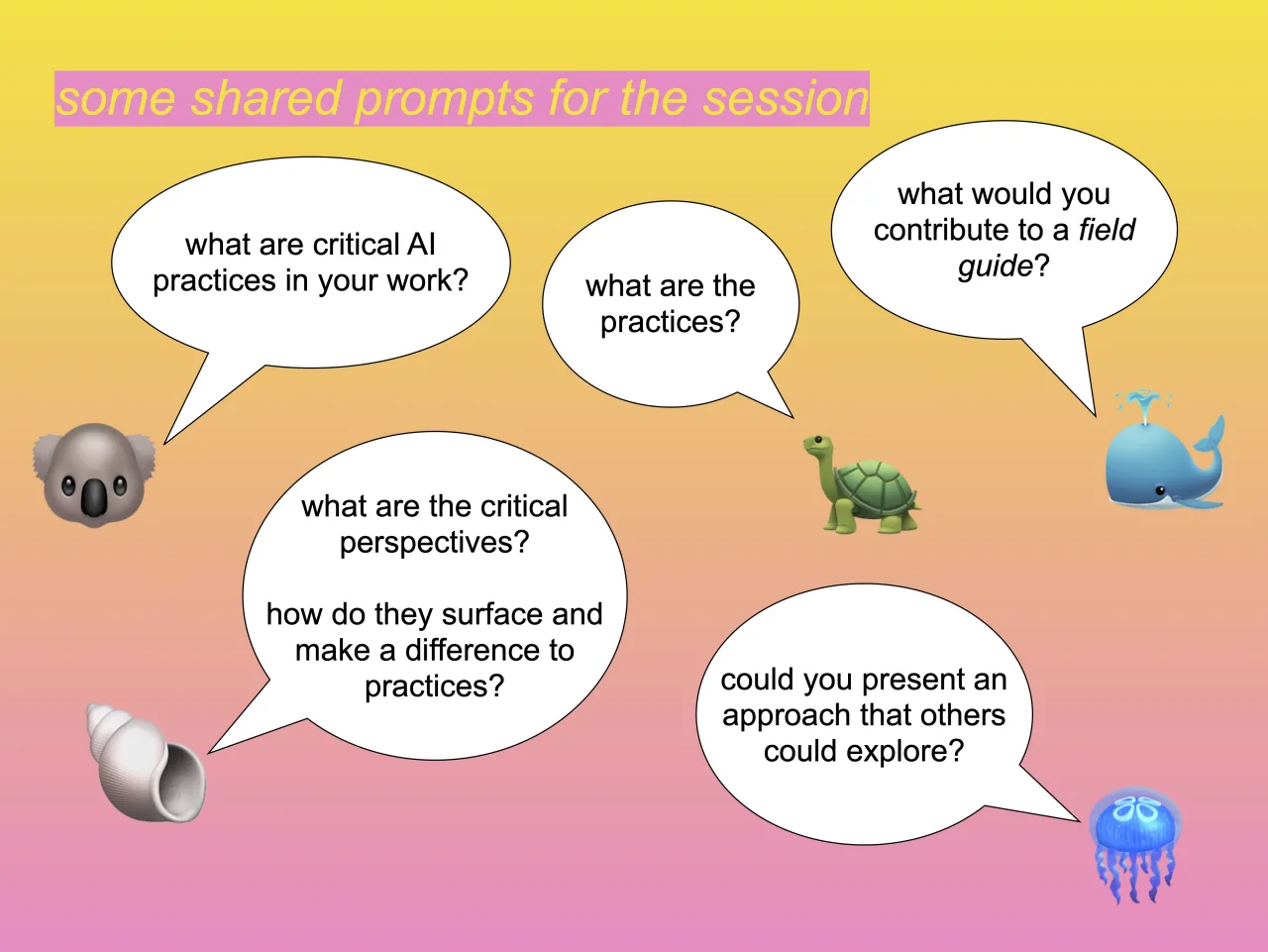
We proposed some prompts for our speakers, to support exchanges towards a field guide to critical AI practices, in the spirit of the Field Guide to “Fake News”:
- what are critical AI practices in your work?
- what are the practices?
- what are the critical perspectives? how do they surface and make a difference to practices?
- what would you contribute to a field guide?
- could you present an approach that others could explore?
To ground the session’s focus on critical AI practices, Daniela van Geenen opened with a discussion of what we have learned from co-editing a special issue on pluralising critical technical practices. She spoke about the emergence of critical technical practices in Agre’s work, as well as how it has been adopted and adapted in various fields - which we review in the special issue introduction, before offering some questions to invite reflection amongst those using the term.
She also mentioned the living archive, shared bibliography and mailing list for those interested in keeping in touch about this area.
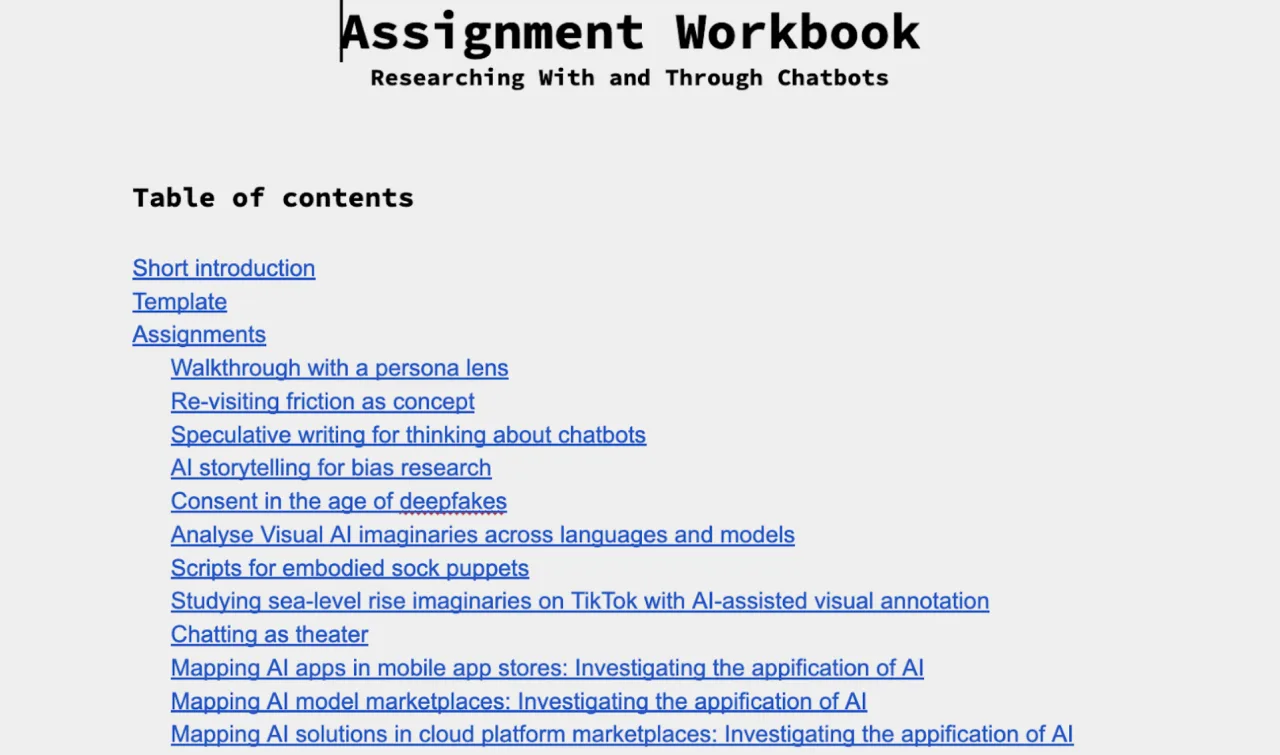
Natalia Sánchez Querubín spoke about a course on “persona as method” focused on studying chatbot and companionship as well as recent symposium she co-organised on “AI & Companionship: Methods for Studying Chatbots” together with Lucia Bainotti and Alex Gekker. She spoke about studying chatbots as media, their material and relational capacities, and exploring “chatbot native” modes of analysis - building on their conversational and generative capacities.
For a field guide, she said she’d explore ways to combine persona methods, app critique and embodied performance - drawing on what she’s been exploring with her students, bringing the body into the study of chatbot companionship.
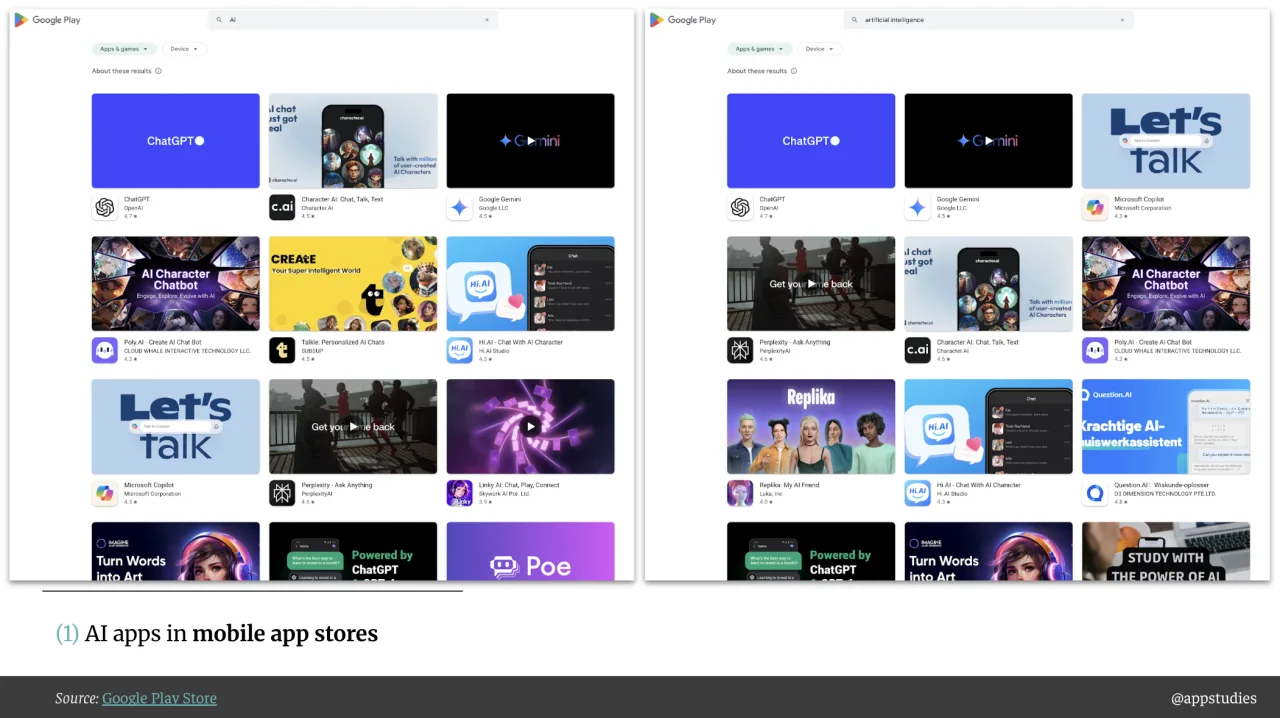
Esther Weltevrede proposed to explore the “appification of AI” through a shift in focus from models to application layers through which AI reaches people, including “apps, marketplaces, assistants, agents, and everyday and enterprise software environments in which AI is packaged, distributed, monetised and made usable”. She mentioned her recent Appification in the Age of AI co-authored with Fernando van der Vlist.
Esther proposed two contributions to a field guide. Firstly, app-ecosystem analysis, treating apps, SDKs and documentation as “empirical entrypoints” to how AI is “classified, promoted, bundled and governed”. The second approach is “AI historiography”, exploring how AI projects are archived, and might be archived differently, which will be examined as part of a Digital Methods Summer School project.
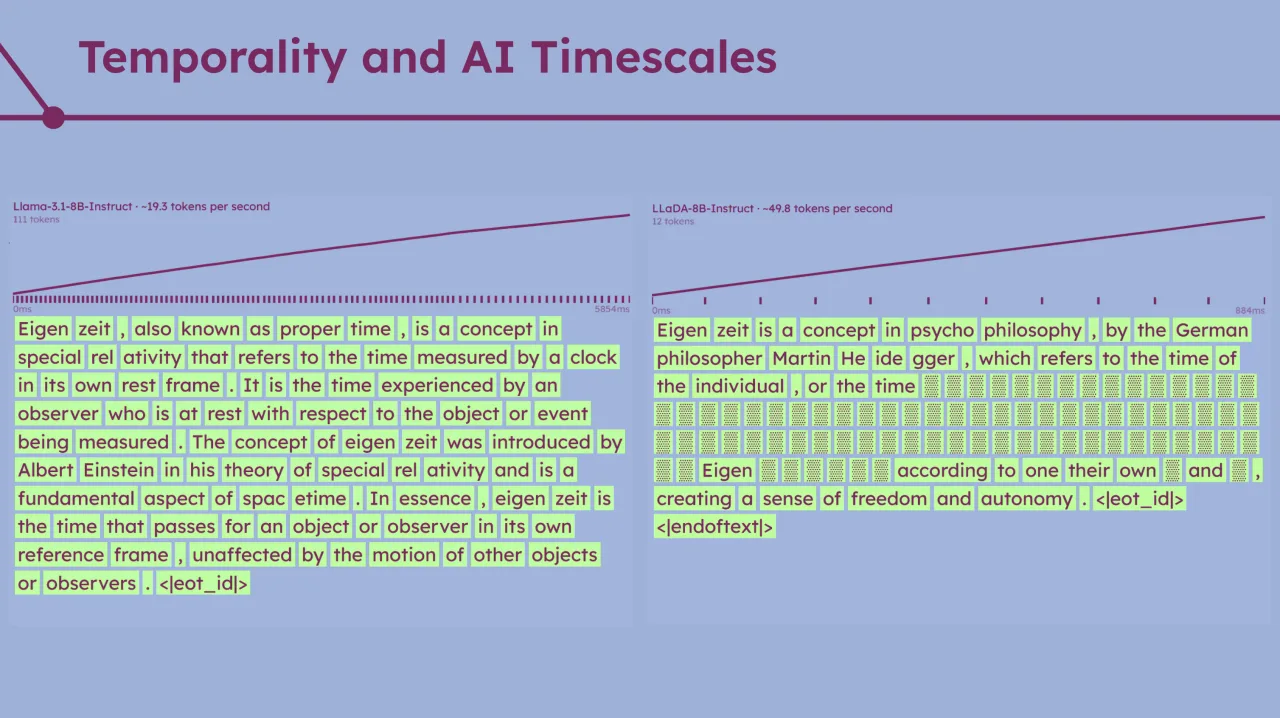
Sal Hagen spoke about his work on the Deep Culture project with Tobias Blanke. As part of this project they look beyond dataset critique and model cultures - developing critical AI practices to repurpose model operations in order to expose their “cracks and glitches” and understand more about how they work and what they do.
Sal presented work on AI Timescales (co-developed with Louis Ravn and Dasha Simons), sonifying the temporal logics of autoregressive and diffusion language models. Here critical engagement is making the different temporalities of these interactive, as a form of what Shintaro Miyazaki calls “critical listening”. The Kenniskrabber tool (created with Stijn Peeters) scrapes Google AI Overviews and AI Mode answers. This was used to gather AI answers associated with Dutch election queries to see how they were citing or paraphrasing sources, as well as leading to epistemic obfuscation.
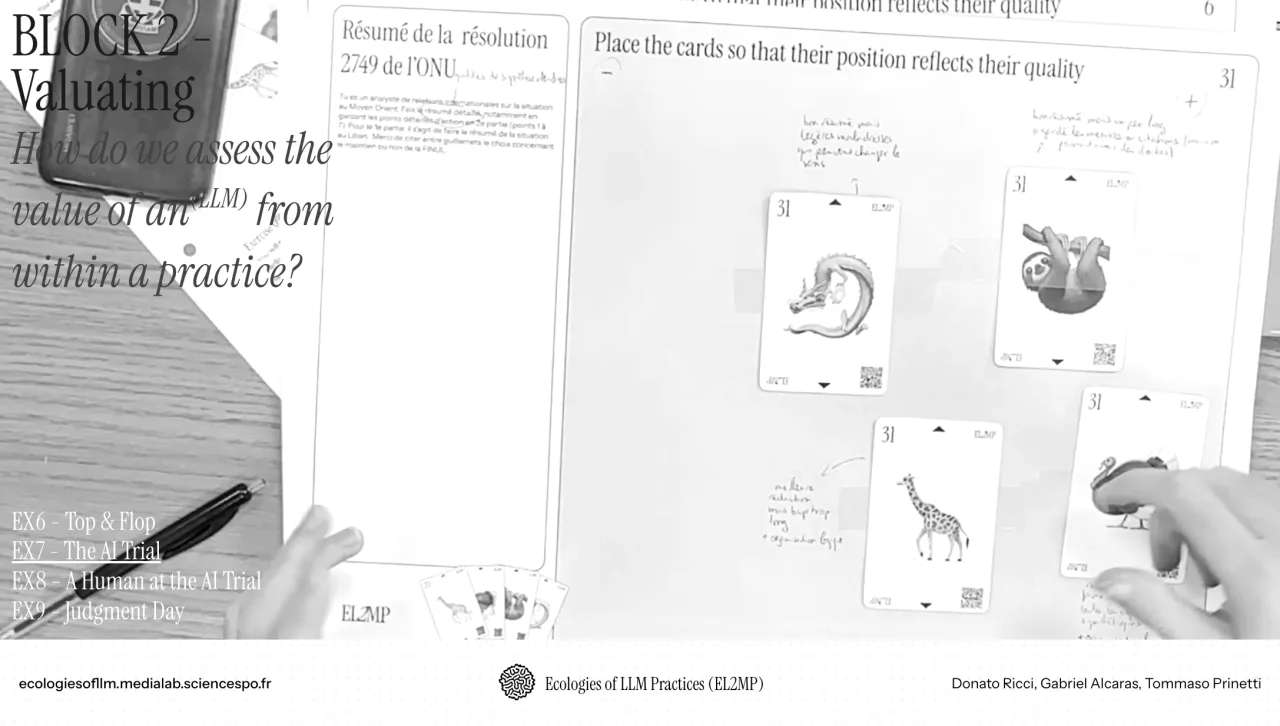
Donato Ricci presented the Ecologies of LLM Practices, which develops “experimental and participatory protocols that allow workers to document and reflect on their everyday interactions with LLMs”, attending to the “situated, evolving ecologies through which these technologies are adopted, contested, and made meaningful”.
He spoke about the work of the collective inquiries and inventive formats group at the Sciences Po médialab to create spaces for participants to explore and reflect on their practices and concerns. Drawing on Noortje Marres and David Stark’s work on the sociology of testing and the tranformation of the world into a laboratory, the project looks at everyday LLM user practices - particularly in professional contexts.
For a field guide, Donato proposed a studio-based approach through hands-on activities with LLMs, to slow down and reflect on use practices - including habits, effects, errors, surprises, hesitations and interruptions. These can be compiled into vignettes and scenes inviting reflection on how we use and live with LLMs, and how we might use them differently.
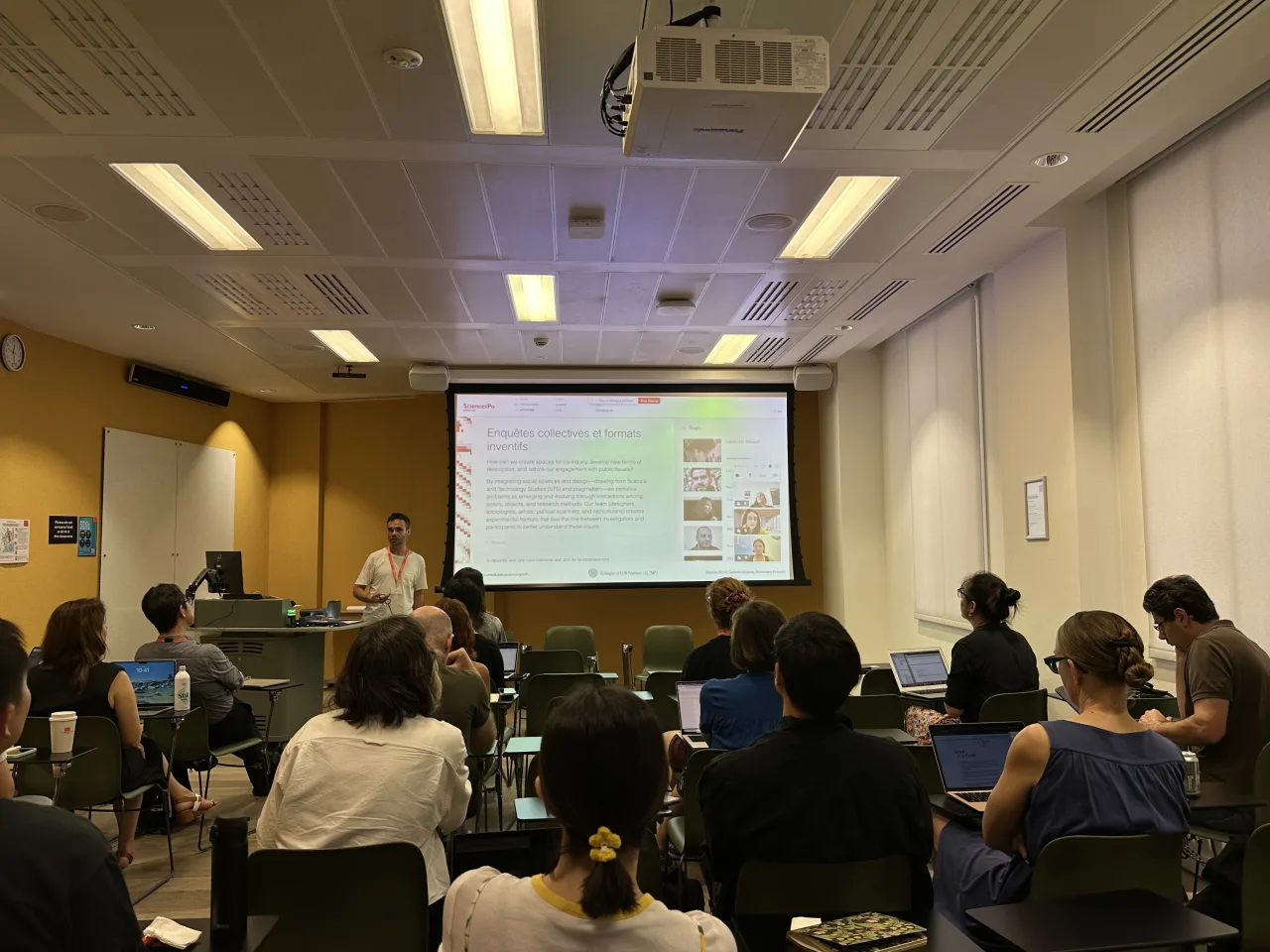
In wrapping up, we spoke about how the session provided different entrypoints for critical AI practices - from interfaces to apps, models to everyday use practices as well as how it invited critical and creative engagements through processes of embodied rescripting, archiving, sonifying, re-compiling and documenting.
After these presentations the Q&A and discussion with the room turned to questions of gender and AI companionship, platform metaphors and platform power, historical understandings of critical technical practices, elaborating the critical dimensions of these various approaches, how platforms incorporate AI overviews and how critique can be grounded in everyday life and experiences.
The session was co-convened with Tobias Blanke (Amsterdam), Liliana Bounegru (KCL), Sal Hagen (Amsterdam), Noortje Marres (Warwick), Sabine Niederer (Amsterdam), Donato Ricci (Sciences Po) and Daniela van Geenen (Siegen), together with other colleagues at the Public Data Lab. If you’re interested in learning more about this work, or would like to get a note when it is shared - please feel free to get in touch.
Thanks so much to our colleagues on the conference committee - Chloé Locatelli, Güneş Tavmen, Jamie Woodcock and Orçun Can - as well as everyone involved in organising, and everyone who joined!